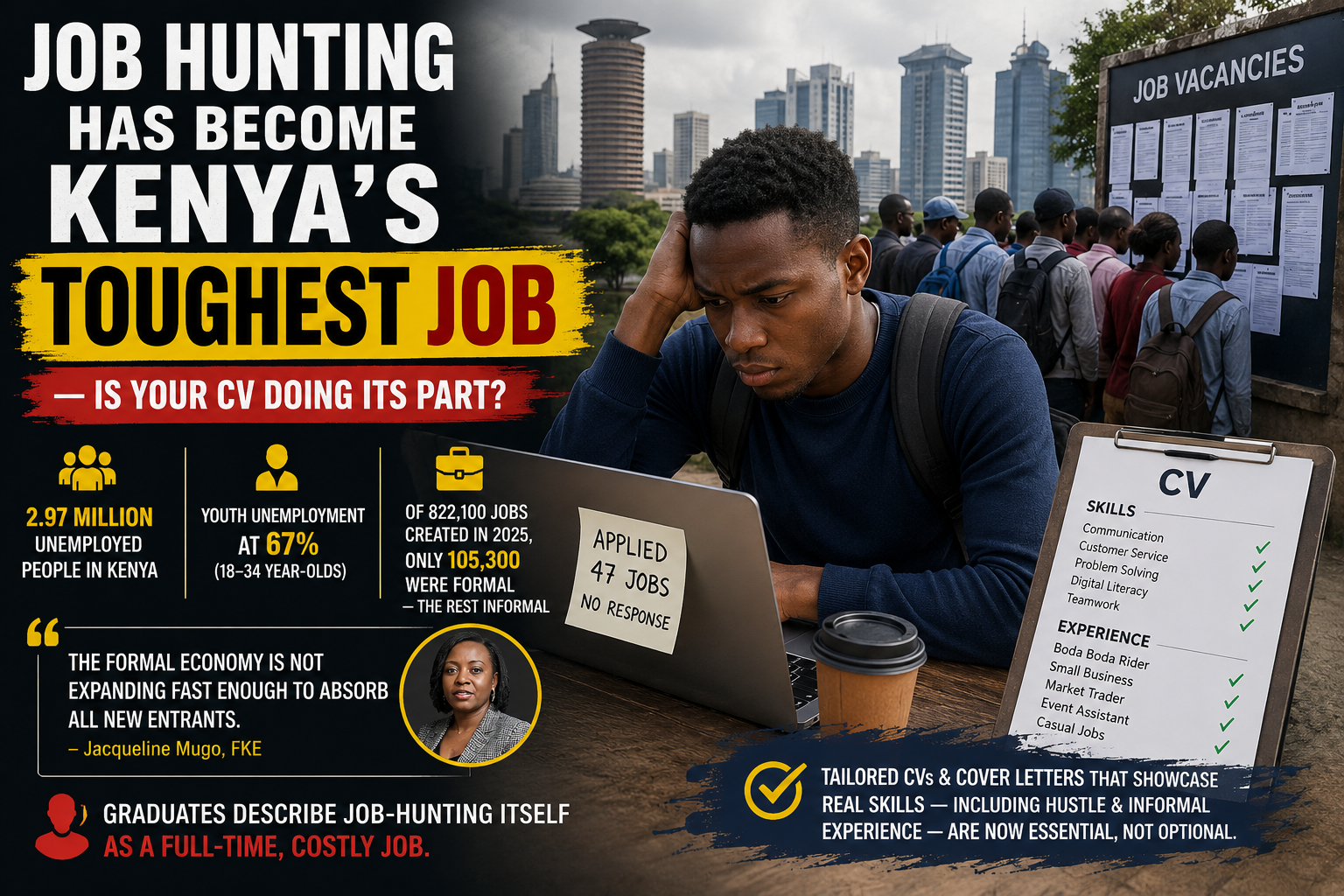
If it feels like finding work has become a full-time occupation of its own, you’re not imagining it. New reporting this week put real numbers to what many job seekers in Kisumu and across Kenya already feel in their bones: Kenya now has an estimated 2.97 million unemployed people, and among Kenyans aged 18 to 34 — who make up 35% of the population — the unemployment rate stands at 67%.
The country still creates jobs. In 2025 alone, 822,100 new jobs appeared, up from 782,300 the year before. But look closer at the split and the real story shows up: only 105,300 of those were formal positions. The other 716,800 were informal — boda boda work, small trade, casual labor, hustles stitched together to get by. Only about 10% of Kenya’s entire workforce holds a formal job today. Meanwhile, somewhere between 800,000 and a million young people enter the labor market every single year, including roughly 50,000 fresh university graduates.
Jacqueline Mugo, executive director of the Federation of Kenya Employers, named the core problem plainly: “the formal economy is not expanding fast enough to absorb all new entrants.” The graduates quoted in the reporting describe the toll this takes. Brian Otieno, a graduate now driving a motorcycle to stay afloat while he keeps applying, put it this way: “Job hunting has become a job itself.” Without that income, he said, he probably would have stopped applying. Mercy Wanjiku, an actuarial science graduate now selling street food, made a point that will resonate with anyone who has budgeted bus fare and printing costs around an interview call: “When you are unemployed, every interview has a cost.”
There’s also what researchers call the “experience paradox” — employers want experience for jobs meant for people just starting out, leaving young jobseekers stuck between needing a first chance and being told they don’t qualify for one.
What this means if you’re job hunting right now
When there are this many people competing for this few formal openings, “good enough” doesn’t cut it. Every application has to work harder than the last one. A few things matter more than ever in this market:
Your CV has to earn a second look in seconds. Recruiters sifting through hundreds of applications for a handful of roles aren’t reading top to bottom — they’re scanning. A cluttered, generic, or poorly formatted CV gets set aside before your actual qualifications are even seen.
Your informal or “hustle” experience is real experience — if it’s framed right. If you’ve been doing boda boda work, running a small stall, doing casual contracts, or freelancing while you search for formal employment, that’s not a gap to hide. It’s proof of initiative, customer service skill, financial discipline, and resilience — but only if it’s written up in language an employer recognizes, not buried or left off entirely.
A cover letter that actually speaks to the role beats a recycled one every time. In a market this competitive, a letter that shows you understand the specific employer’s needs — rather than a one-size-fits-all template — is often what separates a shortlist from a rejection pile.
This is exactly the kind of work Sacramento Writing Services does every day for job seekers across Kenya and worldwide: building CVs and cover letters that are tailored, properly formatted, and honest about the real experience a candidate brings — including the hustle it took to get there. If your CV hasn’t been updated in a while, or you’re not sure it’s pulling its weight in a market this tight, now is the time to get it in shape.
Source: Permanent hustle: millions trapped in Kenya’s job hunt — The Star, August 31, 2026