Research proposal writing is the first real test of any serious academic or funded research journey. Before you ever collect data, run an analysis, or write a single chapter, you must convince a supervisor, a committee, or a funder that your idea is worth their time and money. A strong proposal opens doors. A weak one stalls your entire project before it begins.
The good news is that research proposal writing follows a clear, repeatable structure. Once you understand what reviewers are looking for and how to present your ideas, the process becomes far less intimidating. This guide breaks down seven proven steps that turn a rough idea into a polished, persuasive, and approvable proposal.
Table of Contents
- What is a research proposal?
- Why research proposal writing matters
- Key elements every proposal must include
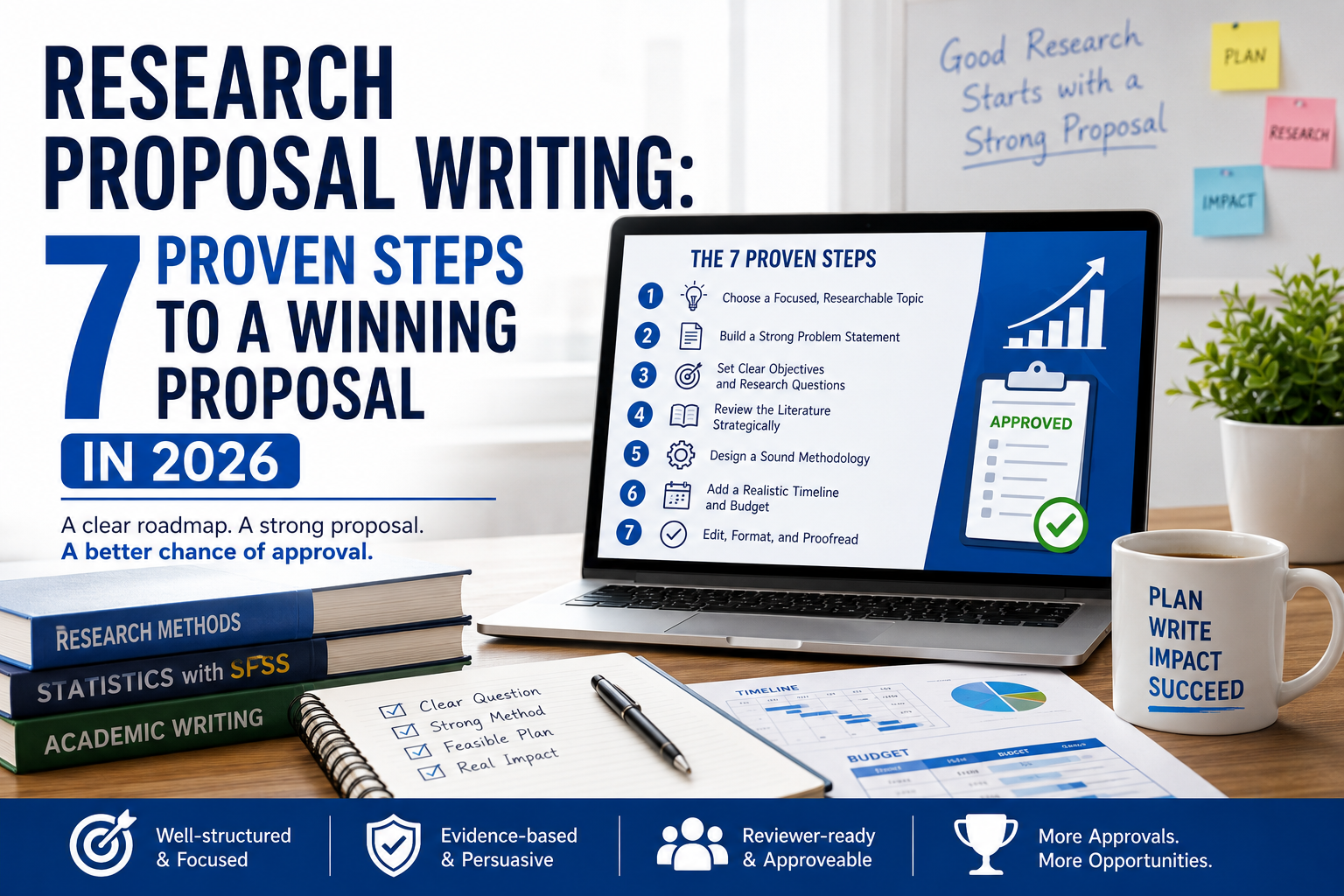
- Research proposal writing: 7 proven steps
- Common mistakes to avoid
- How professional research proposal writing help works
- Frequently asked questions
What Is a Research Proposal?
A research proposal is a structured document that explains what you intend to study, why it matters, and exactly how you plan to carry out the work. It is essentially a roadmap. It tells the reader your research question, the gap your study fills, the methods you will use, and the resources you will need.
Whether you are a master’s student, a doctoral candidate, or a professional seeking grant funding, the purpose is the same. You are making a clear, evidence-based case that your project is important, feasible, and well thought out.
Why Research Proposal Writing Matters
Strong research proposal writing does more than satisfy a formality. It shapes the success of the entire project. A well-built proposal forces you to clarify your thinking early, when changes are still cheap and easy to make.
Reviewers use your proposal to judge three things: the value of your question, the soundness of your method, and your ability to complete the work on time. If any of these is unclear, approval is delayed. Investing effort in research proposal writing up front saves months of frustration later and dramatically improves your chances of acceptance.
Key Elements Every Research Proposal Must Include
While requirements vary slightly between institutions and funders, almost every strong proposal contains the same core components:
- Title: Clear, specific, and focused on your variables.
- Introduction and background: The context and the problem you are addressing.
- Problem statement: The specific gap or issue your study will tackle.
- Research objectives and questions: What you aim to discover.
- Literature review: A summary of existing work and where it falls short.
- Methodology: Your design, sample, instruments, and analysis plan.
- Timeline and budget: Realistic planning that proves feasibility.
- References: Properly formatted citations that show academic rigour.
Each section builds on the one before it. When the parts connect logically, the whole proposal reads as one convincing argument.
Research Proposal Writing: 7 Proven Steps
Here is the step-by-step process that consistently produces strong, fundable proposals.
Step 1: Choose a Focused, Researchable Topic
Many proposals fail because the topic is too broad. Narrow your focus until your question can realistically be answered with the time and resources you have. A sharp, specific topic is the foundation of all good research proposal writing, because everything else flows from it.
Ask yourself whether the topic is original, relevant, and feasible. If you can clearly state who benefits from the answer, you are on the right track.
Step 2: Build a Strong Problem Statement
Your problem statement explains why the study is needed. State the issue plainly, support it with recent evidence, and show the consequences of leaving it unsolved. Reviewers should finish this section thinking, “Yes, someone needs to study this.”
Keep it tight. Two or three well-supported paragraphs are usually more powerful than a page of vague generalisations.
Step 3: Set Clear Objectives and Research Questions
Objectives describe what you want to achieve, while research questions define what you want to answer. They must align perfectly. Each objective should map to at least one question, and each question should be answerable through your chosen methods.
Use measurable, action-oriented language. Vague aims weaken even the best research proposal writing, while precise objectives signal a disciplined researcher.
Step 4: Review the Literature Strategically
A literature review is not a summary of everything ever written on your topic. It is a focused argument that shows what is already known, what remains unknown, and how your study fills that gap. Group sources by theme, compare findings, and highlight contradictions.
Strong literature reviews demonstrate command of your field and justify why your research deserves attention.
Step 5: Design a Sound Methodology
Methodology is where many committees focus their hardest questions. Explain your research design, your population and sample, your data collection tools, and your analysis plan. If you will use statistical software such as SPSS, say so and explain why.
A reviewer should be able to picture exactly how the study will run. Clarity here is the heart of credible research proposal writing.
Step 6: Add a Realistic Timeline and Budget
A beautiful idea with an impossible schedule will not be approved. Break your project into phases, assign realistic durations, and account for delays. For funded work, build a transparent budget that ties every cost to a specific activity.
Feasibility reassures reviewers that you can actually deliver what you promise.
Step 7: Edit, Format, and Proofread
The final step separates good proposals from great ones. Check that every section connects, that your citations follow the required style, and that the document is free of typos and formatting errors. Read it aloud, then have someone else review it.
Polished presentation signals professionalism, and professionalism builds trust. This is why careful editing is an essential part of research proposal writing.
Common Mistakes to Avoid in Research Proposal Writing
Even talented researchers lose marks on avoidable errors. Watch for these:
- A topic that is too broad to complete in the available time.
- Objectives and questions that do not match, which confuses reviewers.
- A literature review that only describes instead of analysing.
- Vague methodology that leaves key decisions unexplained.
- Ignored formatting rules, especially for citations and referencing.
- Unrealistic timelines that undermine your credibility.
Avoiding these pitfalls instantly raises the quality of your work and improves your approval odds.
How Professional Research Proposal Writing Help Works
Sometimes the smartest move is to bring in experienced support. Professional research proposal writing help connects you with specialists who understand academic standards, methodology, and the expectations of supervisors and funders across disciplines.
A good service does not write generic content. It works with your topic, your objectives, and your institution’s guidelines to produce a tailored, original proposal that reflects your voice. Support can cover the full document or specific sections such as the literature review, methodology, or data analysis plan.
At Sacramento Writing Services, our team supports postgraduate students, NGOs, and professionals worldwide with research proposals, dissertations, statistical analysis, and grant writing. Whether you need full development or a careful second opinion, expert help is available.
Frequently Asked Questions
How long should a research proposal be?
Length varies by institution, but most fall between 1,500 and 3,500 words. Always follow your specific guidelines, since reviewers notice when limits are ignored.
How long does research proposal writing take?
With a clear topic, most proposals take one to three weeks to draft and refine. Allow extra time for literature searching and supervisor feedback.
Can I get help without losing originality?
Yes. Reputable research proposal writing support is collaborative and confidential, producing original, plagiarism-free work built around your own ideas and objectives.
What if my proposal is rejected?
Rejection usually points to fixable problems, such as an unclear question or weak methodology. Use the feedback, revise carefully, and resubmit with a stronger argument.
Final Thoughts
Research proposal writing rewards clarity, structure, and persistence. Follow the seven steps in this guide, avoid the common mistakes, and your proposal will read as a confident, fundable plan rather than a rough idea. Start early, stay focused, and refine relentlessly.
If you would like expert support at any stage of your research proposal writing, our team is ready to help you build a proposal that earns approval.
Get in touch with Sacramento Writing Services
Email: info@sacramentowritingservices.com
WhatsApp: https://wa.me/254712628632
Website: https://www.sacramentowritingservices.com