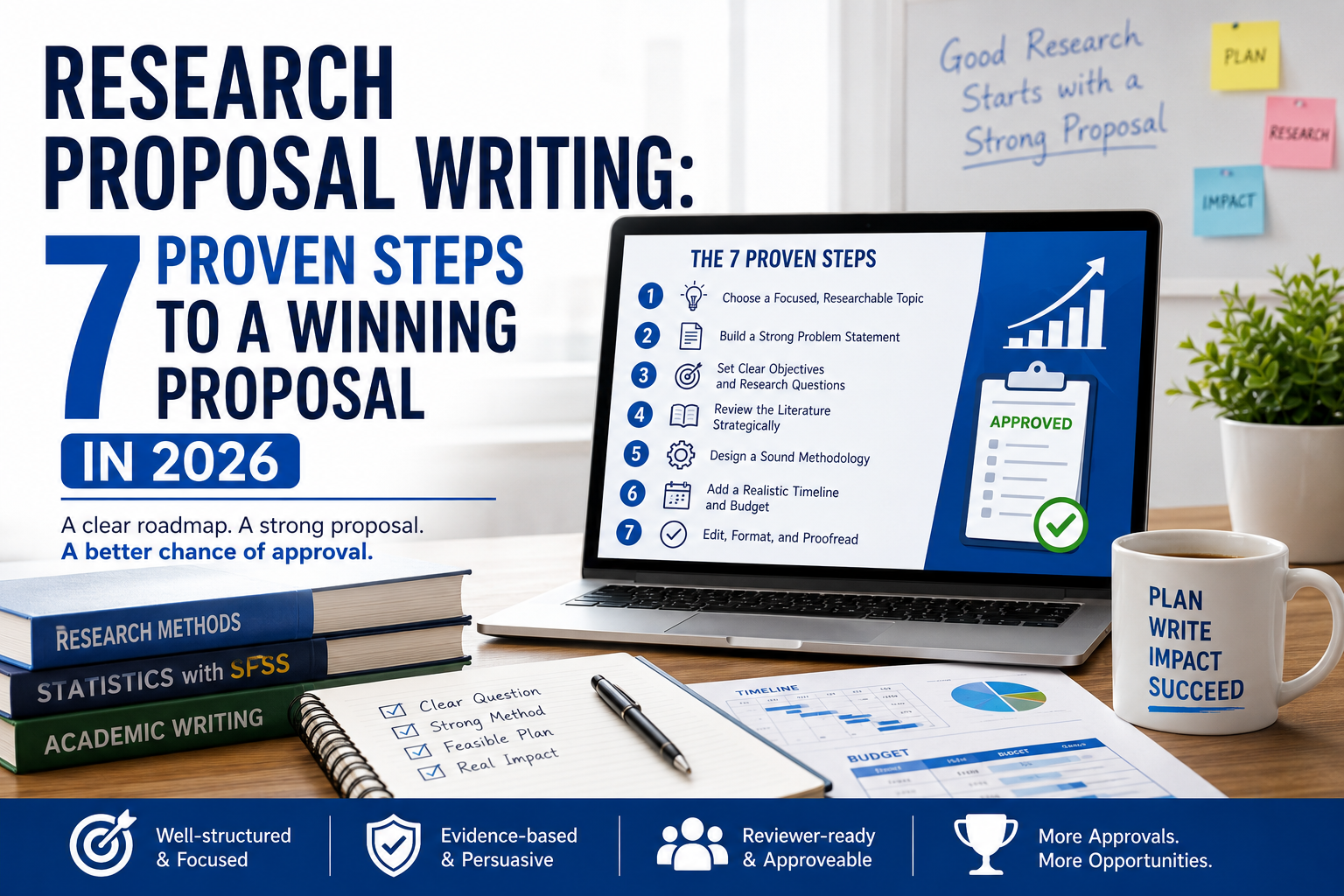
Writing a literature review is one of the most demanding stages of any thesis, dissertation, or research project — and for many postgraduate students, it is also the most confusing. A strong literature review does far more than summarise what other researchers have said. It builds the intellectual foundation of your study, shows that you understand your field, and justifies why your own research matters. This guide breaks the entire process down into clear, manageable steps so you can write a literature review that is organised, critical, and genuinely persuasive.
Whether you are drafting your first review or revising one your supervisor has already sent back, the principles below apply across disciplines and institutions worldwide.
What Is a Literature Review?
A literature review is a structured, critical analysis of the existing scholarship on a specific topic. It gathers the most relevant books, journal articles, and other sources related to your research question, then synthesises them to show what is already known, where scholars disagree, and what gaps remain.
It is important to understand what a literature review is not. It is not a list of summaries, where you describe one source after another with no connection between them. A well-written literature review weaves sources together around themes, debates, and trends. The emphasis is on analysis and synthesis, not description.
In a thesis or dissertation, the literature review usually appears early — often as the second chapter — and sets up the rationale for everything that follows. In a standalone review article, it is the entire piece of work.
Why the Literature Review Matters
Examiners and supervisors pay close attention to the literature review because it reveals how deeply you understand your field. A confident, well-organised review signals that you have read widely, thought critically, and identified a genuine contribution your research will make.
The literature review serves several specific purposes:
- It demonstrates your command of the existing scholarship and key debates.
- It identifies the gap your study will address, justifying your research question.
- It establishes the theoretical and methodological framework for your work.
- It positions your study within an ongoing scholarly conversation rather than in isolation.
When done well, the literature review makes the rest of your dissertation feel inevitable — the reader understands exactly why your study needed to happen.
Types of Literature Reviews
Before you start writing, it helps to know which kind of review your project requires, because the structure and depth differ considerably.
A narrative (or traditional) review offers a broad overview of a topic, summarising and interpreting the literature thematically. This is the most common type in taught postgraduate dissertations.
A systematic review follows a strict, transparent protocol to identify, select, and appraise all relevant studies on a tightly defined question. It is common in health sciences, nursing, and evidence-based disciplines, and it minimises bias through reproducible methods.
A meta-analysis goes one step further than a systematic review by statistically combining the numerical results of multiple studies to produce a pooled finding.
A scoping review maps the breadth of available evidence on a wider topic, often to identify where future research is needed rather than to answer a single precise question.
Confirm with your supervisor which type your programme expects before you invest weeks in the wrong approach.
How to Write a Literature Review: Step by Step
The process below works for almost any discipline. Treat it as a sequence — each step builds on the one before it.
Step 1: Define Your Scope and Research Question
Start by narrowing your focus. A literature review built around a vague topic such as “social media” will sprawl out of control, while one anchored to a precise question — for example, “How does short-form video marketing affect purchase intention among Gen Z consumers?” — gives you clear boundaries for what to include and exclude.
Write down your research question and a short list of the key concepts within it. These concepts become your search terms in the next step.
Step 2: Search for Relevant Sources
With your concepts defined, begin a systematic search. Use academic databases and search engines rather than relying on general web results. Google Scholar is an excellent free starting point, and most university libraries provide access to subject-specific databases such as Scopus, Web of Science, PubMed, JSTOR, and others relevant to your field.
Combine your key terms using Boolean operators (AND, OR, NOT) to refine your results, and keep a record of which search terms and databases you used. Save every promising source as you go — losing track of citations is one of the most common and avoidable sources of stress later on.
Step 3: Evaluate and Select Your Sources
You will quickly gather more sources than you can use, so you need to evaluate them critically. For each one, ask whether it is credible (peer-reviewed, from a reputable publisher or author), relevant to your question, and current enough to matter — though seminal older works should never be excluded simply for being old.
Prioritise primary research and high-impact journal articles over secondary commentary. Aim for a balance between foundational studies that established the field and recent publications that show where the conversation stands today.
Step 4: Identify Themes, Debates, and Gaps
This is the analytical heart of the literature review. As you read, look for patterns: Where do scholars agree? Where do they contradict one another? Which methods recur, and which are contested? Most importantly, what has not been studied?
A useful technique is to build a synthesis matrix — a simple table where each row is a source and each column is a theme or variable. Filling it in makes recurring themes and obvious gaps visible at a glance, and it transforms a stack of disconnected articles into a structured argument.
Step 5: Outline the Structure
Never write a literature review without an outline. Organise your review around themes or debates rather than around individual sources. A thematic structure forces you to synthesise, while a source-by-source structure pushes you back toward mere summary.
Common organising principles include thematic (grouped by topic or concept), chronological (tracing how thinking has evolved over time), and methodological (grouping studies by the approach they used). Thematic organisation is the most widely used and usually the most effective.
Step 6: Write the Review
With a clear outline, drafting becomes far more manageable. Structure your literature review into three broad parts.
The introduction defines the scope, explains your organising principle, and previews the main themes. The body presents your synthesis theme by theme, comparing and contrasting sources and using clear topic sentences to guide the reader. The conclusion summarises the key insights, restates the gap your research addresses, and links directly to your own study.
Throughout, write critically rather than descriptively. Instead of “Smith (2021) found X, and Jones (2022) found Y,” aim for “While Smith (2021) argues X, Jones (2022) challenges this on methodological grounds, suggesting that…” The second version analyses; the first merely reports.
Step 7: Edit, Format, and Proofread
A brilliant analysis can be undermined by careless presentation. Once your draft is complete, revise for argument and flow first, then for clarity at sentence level, and finally for formatting and citations.
Make sure every in-text citation has a matching reference and that your formatting follows the required style — APA, Harvard, MLA, Chicago, or whichever your institution mandates. The Purdue Online Writing Lab is a reliable free reference for the major citation styles. A reference manager such as Zotero can automate much of this and save hours of manual formatting.
A Reliable Literature Review Structure
If you are unsure how to lay out your chapter, the following structure works for most thesis and dissertation literature reviews:
- Introduction — scope, purpose, and how the review is organised.
- Theoretical framework — the key theories or models underpinning your study.
- Thematic sections — the bulk of the review, organised around two to five major themes.
- Identification of the gap — a clear statement of what the literature has not yet addressed.
- Conclusion — synthesis of the main findings and the bridge to your own research.
Adjust the number of thematic sections to suit the breadth of your topic, but keep each one focused on a single clear idea.
Common Mistakes to Avoid
Even strong students fall into predictable traps when writing a literature review. Watch for these:
Summarising instead of synthesising. This is the single most common weakness. If your review reads like a series of book reports, restructure it around themes.
Being uncritical. Accepting every source at face value signals shallow engagement. Examiners want to see you weigh evidence and identify limitations.
Ignoring recent research. A review that stops several years before your submission date suggests you have not kept up with the field.
Poor organisation. Without a clear thematic or chronological logic, readers get lost. Strong topic sentences and signposting solve this.
Inconsistent citations. Mismatched or missing references damage credibility instantly and are entirely avoidable with a reference manager.
Tools and Resources That Help
A few well-chosen tools make the literature review far more manageable. Reference managers like Zotero and Mendeley store your sources and generate citations automatically. Databases such as Google Scholar and your institution’s library portal give you access to peer-reviewed material. For methodology and writing guidance, established academic resources such as Scribbr offer detailed, discipline-neutral explanations of every stage of the dissertation process.
If you are also handling quantitative data alongside your review, you may find our guide to statistical data analysis and SPSS support useful, since many literature reviews feed directly into a study’s analytical framework.
Frequently Asked Questions
How long should a literature review be?
There is no universal length. As a rough guide, a literature review chapter in a master’s dissertation is often 3,000–6,000 words, while a doctoral review can run considerably longer. Always follow your institution’s specific requirements.
How many sources do I need?
Quality matters more than quantity, but a master’s literature review typically engages with 30–50 sources, and a doctoral review with many more. The right number depends on how established your topic is.
Can I include older sources?
Yes. Seminal, foundational works should be included regardless of age. The key is to balance these with current research so your review reflects both the origins and the present state of the field.
What is the difference between a literature review and an annotated bibliography?
An annotated bibliography lists sources with individual summaries and is not woven into a single argument. A literature review synthesises sources around themes to build a unified, critical narrative.
When to Get Professional Support
Writing a literature review takes time, critical reading, and a great deal of revision — and many postgraduate students are balancing this work alongside jobs, families, and other commitments. If you are struggling to structure your review, synthesise your sources, or meet a tight deadline, expert support can make a decisive difference.
At Sacramento Writing Services, we provide professional thesis and dissertation writing support to postgraduate students worldwide, including literature review development, structuring, editing, and formatting across every major referencing style. We work remotely with students across disciplines — from the social sciences to nursing, engineering, and beyond. You can also explore our subject-specific assignment support if your project sits in a specialised field.
A well-written literature review sets the tone for your entire study. Get it right, and the rest of your dissertation becomes far easier to build.
Ready to strengthen your literature review? Get in touch with our team today.
Email: info@sacramentowritingservices.com
WhatsApp: wa.me/254712628632
Website: www.sacramentowritingservices.com