Chemical engineering is one of the most demanding degrees a student can take on. It sits at the crossroads of chemistry, physics, mathematics, and process design, and the assignments reflect that. A single problem set might ask you to balance a multi-stage separation unit, derive a rate law from experimental data, and then size a heat exchanger – all in one sitting. It is no surprise that students across the world search for clear, reliable chemical engineering assignment help when deadlines stack up.
This guide breaks down the assignment types you will meet most often, the reasons they trip students up, and a practical approach to working through them. Whether you are in your first year wrestling with material balances or finishing a capstone design project, the goal is the same: understand the method, not just the answer.
Why chemical engineering assignments are so challenging
Most students do not struggle because they are incapable. They struggle because chemical engineering assignments combine several skills at once, and a weakness in any one of them shows up in the final answer.
A typical question demands that you set up the physical situation correctly, choose the right governing equations, handle the unit conversions without slipping, carry out the algebra or calculus accurately, and then interpret whether the result is physically sensible. Miss one step and the whole solution falls apart. Add the pressure of tight deadlines, heavy course loads, and assignments that assume you already remember last semester’s thermodynamics, and the difficulty compounds quickly.
Understanding where the difficulty comes from is the first step to managing it. Below are the assignment categories that cause the most trouble, with guidance on how to approach each.
Mass and energy balances
Mass and energy balances are the foundation of the entire discipline, which is why they appear in nearly every course. They are also where many students first lose confidence.
The most common mistake is rushing into calculations before properly defining the system. Before writing a single equation, draw a clear process flow diagram, label every stream, and mark your system boundary. Decide whether the process is steady-state or unsteady-state, and whether there is a chemical reaction involved, because that determines which form of the balance equation you use.
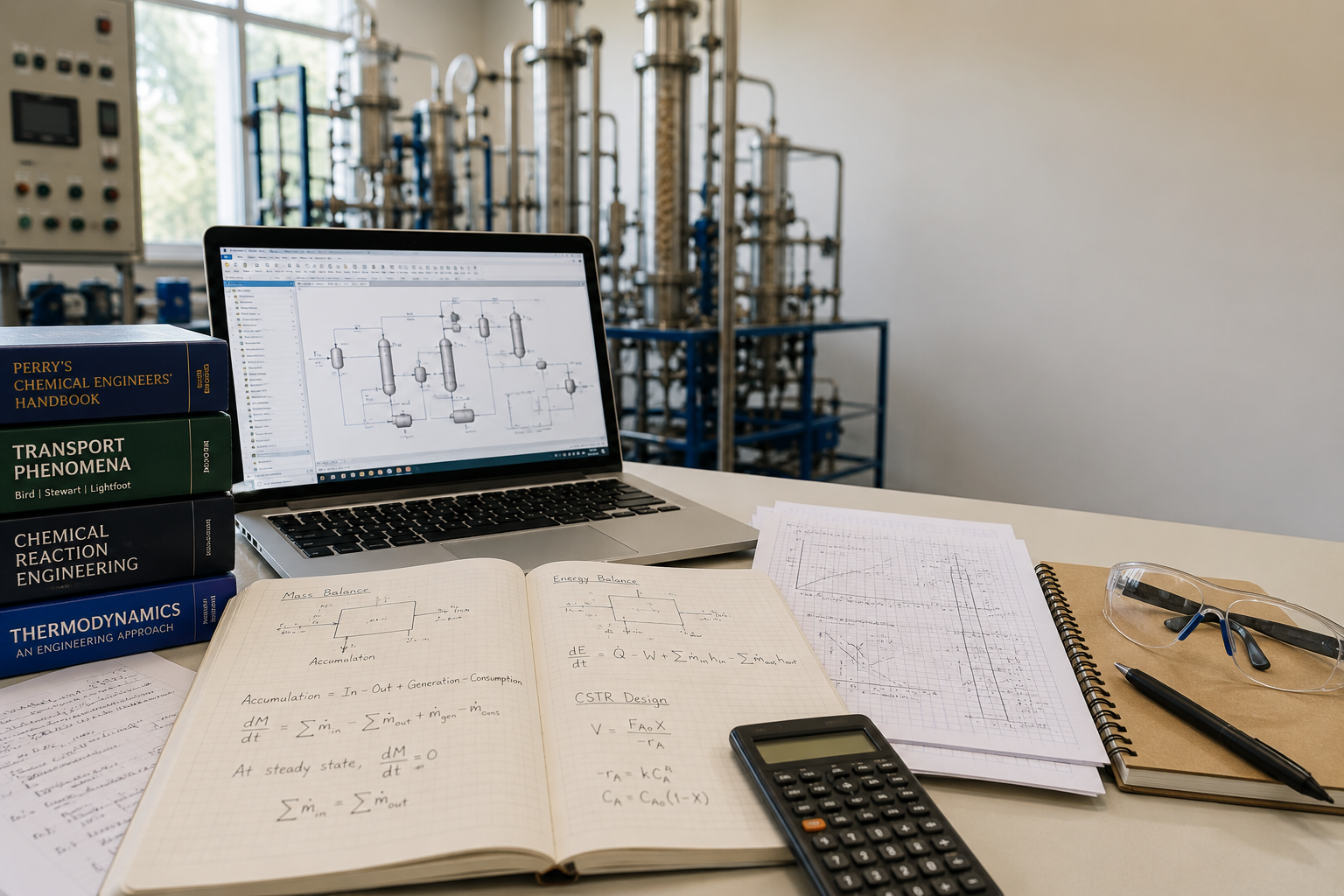
A reliable approach is to always start from the general balance: accumulation = input − output + generation − consumption. For a steady-state process with no reaction, this collapses to input = output, which is far simpler. Choosing a sensible basis — say, 100 kg of feed or one hour of operation — keeps your numbers manageable. Work the problem symbolically as far as you can before substituting values, so that errors are easier to spot.
Thermodynamics and phase equilibria
Thermodynamics is conceptually heavy, and assignments often blend abstract theory with detailed calculation. Students get stuck on questions involving enthalpy and entropy changes, vapour-liquid equilibrium, equations of state, and the behaviour of non-ideal mixtures.
The key here is to be ruthlessly clear about your reference states and your assumptions. Are you treating the gas as ideal, or do you need the van der Waals or Peng-Robinson equation of state? Is the system adiabatic, isothermal, or neither? Many wrong answers come not from bad arithmetic but from an assumption that was never stated and quietly contradicts the problem. Get comfortable reading steam tables, thermodynamic charts, and property data, because assignments will assume you can pull values from them quickly and correctly.
Fluid mechanics and transport phenomena
Fluid flow, heat transfer, and mass transfer — often grouped as transport phenomena — bring a strong mathematical edge to chemical engineering. Assignments may ask you to calculate pressure drops across piping networks, determine whether flow is laminar or turbulent using the Reynolds number, or solve differential equations describing concentration and temperature profiles.
The students who handle these well are the ones who connect the equation to the physical picture. Before solving, ask yourself what the system is actually doing: is heat moving by conduction or convection, is the flow developing or fully developed, are you in a steady or transient state? Dimensional analysis is your friend here. Checking that your units cancel correctly will catch a surprising number of errors before they reach your final answer.
Reaction engineering and reactor design
Reaction engineering ties chemistry to equipment. Assignments commonly involve deriving rate laws, sizing batch, CSTR (continuous stirred-tank reactor), and PFR (plug flow reactor) systems, and analysing how conversion changes with temperature, pressure, and residence time.
The trick is to keep the mole balance, the rate law, and the stoichiometry as three distinct pieces that you assemble deliberately, rather than trying to do everything in one tangled expression. Sketch conversion-versus-volume behaviour where you can, because a graph often reveals whether your answer is reasonable. When comparing reactor types, reason about why a CSTR or PFR gives a particular conversion before committing to the numbers.
Process design and simulation projects
In the later years of study, assignments grow into full design projects. You might be asked to design a distillation column, develop a complete process flowsheet, run an economic analysis, or model a process in simulation software such as Aspen Plus, HYSYS, or DWSIM.
These projects reward planning and presentation as much as calculation. Marks are lost not only on the engineering but on unclear reports, missing assumptions, poorly labelled diagrams, and weak justification of design choices. Treat the write-up as part of the engineering: state your assumptions, show your method, and explain your decisions in clear, professional language.
A practical study strategy that works
Across every one of these topics, the same habits separate students who cope from students who struggle.
Start assignments early, while there is still time to ask questions. Read the problem twice before attempting it, and restate what is being asked in your own words. Always sketch the system before calculating. Keep a personal formula sheet and a record of worked examples you understand, so revision is faster. And when you are stuck, seek guidance on the method rather than simply hunting for a final number — understanding the approach is what carries you into the exam and the next assignment.
If a particular topic keeps defeating you despite genuine effort, getting expert support early is far wiser than handing in work you do not understand or missing the deadline entirely.
Get expert chemical engineering support
At Sacramento Writing Services, we support chemical engineering students worldwide with the parts of their coursework that cause the most difficulty. Our help is built around understanding, not shortcuts. We work alongside students to explain difficult concepts, walk through worked examples step by step, structure and format technical reports to academic standards, check solutions and provide detailed feedback, and offer one-to-one guidance on design projects and simulations.
Our team brings real subject expertise across mass and energy balances, thermodynamics, transport phenomena, reaction engineering, and process design. We serve students remotely across the globe, so wherever you are studying, professional support is within reach.
If you are preparing for a tough assignment, a design project, or an upcoming exam, we can help you approach it with confidence. For thesis support, check on here
Get in touch with Sacramento Writing Services:
- Email: info@sacramentowritingservices.com
- WhatsApp: https://wa.me/254712628632
- Website: www.sacramentowritingservices.com
Reach out today and turn a stressful assignment into a chance to master the material.